
Getty Images
For these studies, researchers used data from participants in the UW ADRC Clinical Core, with gratitude.
Neuropathology and 'SuperAgers'
Super agers show unique cell signatures in the brain // C. Dirk Keene. A. Disouky et al. Nature, Feb 2026
“Super agers” are people over 80 whose brains show remarkable memory and cognitive function. This study reports that people whose brains continue to produce new neurons have better cognitive function than those whose neurogenesis slows with age.
The researchers studied autopsied brains of participants at different stages of cognitive health - superagers and people with normal cognition, preclinical Alzheimer's disease, and dementia. The super agers came from the Northwestern University ADRC and all other samples came from the UW ADRC and the affiliated Adult Changes in Thought Study.
The study found that super agers had twice the neurogenesis of the other healthy older adults. People who had been experiencing cognitive decline or Alzheimer’s disease showed far fewer immature neurons.
This profile of neurogenesis is a new “resilience signature” in the human brain. It could help researchers identify strategies to protect brain health as people age.
Blood Biomarkers of Alzheimer’s disease

Blood-based biomarkers and the contribution of ADRC research participants //2025
Emerging evidence points to inflammation as playing a critical role in Alzheimer’s and brain health. However, a reliable blood-based biomarker of inflammation has not yet been identified. In her lab at UW Medicine, Lynn Bekris, PhD, Leader of the ADRC Biomarker Core, focuses on using blood-based biomarkers to study the immune response in Alzheimer's disease and related dementias. She uses circulating biomarker results from individuals in the ADRC cohort to detect early inflammatory changes associated with neurodegenerative disease.
Dr. Bekris says that ADRC participant data are helping her conduct critical research projects. In ongoing work, she is finding distinct patterns of immune responses across different stages of Alzheimer’s disease and types of pathological progression. “In just a drop of blood, we can measure over a hundred, or even over a thousand, immune-related proteins,” she says. The team can then group the different proteins by their relationship with brain biology. These findings provide specific information on the role of the immune system in neurodegeneration. Learn more about what she is discovering.

Plasma biomarkers of Alzheimer’s disease in American Indians: The Strong Heart Study // Astrid Suchy-Dicey et al. Alzheimers Dementia, Mar. 2024
A blood test for Alzheimer’s disease and related dementias would provide an inexpensive, noninvasive way to detect and diagnose these diseases in clinics and research. The authors have completed the first report on the accuracy of blood tests for Alzheimer’s disease and other brain diseases among older American Indian individuals. The team collected blood in 401 participants in the Strong Heart Study, and they analyzed markers of four different molecules known to be involved in Alzheimer’s and other dementias. They found that a panel of all four markers, alongside age, sex, and education level, worked best to diagnose dementia in the American Indian and Alaska Native population.
Genetics (APOE ε4) and Resistance to Alzheimer's
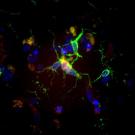
Image courtesy of Alexandra Cochoit, UW Neurology
Scientists find genetic factor tied to African ancestry that protects against Alzheimer’s // Julianna Brutman, Paul Valdmanis, Suman Jayadev, Elizabeth Blue, Ellen Wijsman
Some individuals who show signs of Alzheimer’s disease in brain scans and biomarker tests continue to perform well on cognitive tests. This phenomenon, known as resistance, suggests that certain biological mechanisms may naturally protect the brain from AD-related damage. Understanding why these individuals remain cognitively resilient despite significant AD pathology could open the door to new therapeutic strategies. Kevin Lin, assistant professor of biostatistics in the UW School of Public Health, is working on new statistical methods to better understand whether certain brain cells have a "superpower" that shields them from the effects of Alzheimer’s. The team’s approach integrates large-scale single-cell RNA sequencing data with statistical methods that account for human variability, cognitive resilience, and potential confounding factors. By doing so, it aims to extract meaningful insights into how certain individuals resist cognitive decline despite extensive AD pathology.
Dementia-Friendly Health and Social Policy

What Makes a Better Life for People Facing Dementia? Toward Dementia-Friendly Health and Social Policy, Medical Care, and Community Support in the United States // Barak Gaster and Emily Largent. The Hastings Center Report, Feb. 2024
People living with memory loss and caregivers deserve to experience fulfilling lives within a community of support. But as the authors point out, “the US does not have a dementia care system that is universally available and not reliant on the labor and resources of unpaid family caregivers.” They argue that well-funded and coordinated dementia care programs would lessen caregiver burden and improve the lives of people with dementia. They advocate for payment for dementia care managers and for new systems to deliver high-quality palliative care tailored to the symptoms of dementia. These changes could inform discussions around advance care planning and respecting wishes for end-of-life care.
Improving diagnosis of CADASIL and early-onset Alzheimer’s disease

NOTCH3 C201R variant causes cerebral autosomal dominant arteriopathy with subcortical infarcts and leukoencephalopathy (CADASIL) that can be confused with early-onset Alzheimer's disease // Olena Korvatska et al. Neurol Sci. Sept. 2023
CADASIL is a neurological condition associated with both stroke and dementia, caused by a mutation in the NOTCH3 gene. But when a person develops dementia as a first symptom of CADASIL, it can be very difficult to distinguish the condition from dementia caused by Alzheimer’s disease. Researchers searched the genetic codes of individuals from three generations of a large family affected by inherited Alzheimer’s disease. These family members have a decades-long history of ADRC research participation. Among affected family members, the team found a specific variant of the NOTCH3 gene that causes a condition of early-onset dementia. This finding revealed that the inherited disease in this family is caused by CADASIL, not Alzheimer’s disease. This knowledge will help individuals at risk for this condition to receive more tailored genetic testing, counseling, and resources.
View More 'Discoveries Made Possible By You' Research Study Summaries

__media-listing.png)


