
by James Gregory
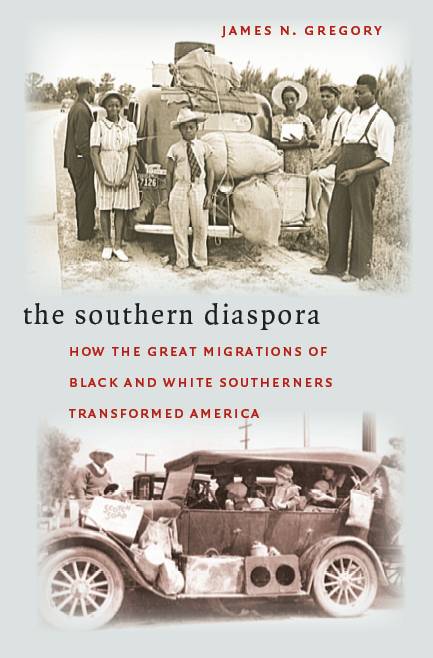
What is a diaspora? A mass migration? When do the ordinary relocations of people become extraordinary enough to earn a label? The answers are not precise. Mass migrations happen when the spatial moves of lots of people form a pattern that is recognized by participants or by hosts or others who have the capacity to publicize their observations. Mass migrations have as much to do with ways of noticing as with ways of moving. The term “diaspora” is of Greek origin and rst was used to denote the colonizing migrations of the Hellenist world, then acquired a dierent meaning in association with the expulsion of Jews from ancient Israel. More recently, the meanings have shifted back toward the original. The term now describes historically consequential population dispersions of various descriptions, those inspired by opportunity as well as by oppression. I use the term “Southern Diaspora” to denote an era and a process of exceptionally heavy population movement out of the South, an era that covers the rst three-quarters of the twentieth century.
Read "A Century of Migration" Chapter 1 in James N Gregory, The Southern Diaspora: How the Great Migrations of Black and White Southerners Transformed America (University of North Carolina Press, 2005)