
Contributed by Ava Sophie, 8th grade, Bellevue School District
When you are a kid, you don’t expect your life to change in a way that feels too big to process all at once. You expect school, friends, sports, maybe some drama here and there, but not a disease that slowly takes your parent away. My name is Ava, and I was only 11 years old when my dad was diagnosed with younger-onset Alzheimer’s disease. I didn’t know what that meant at first. I just knew something was happening to him, and I couldn’t stop it. It didn’t take long before the reality of my dad’s diagnosis began affecting not just him, but it affected my whole family. It has been a difficult journey, and sharing my experience matters to me because I want other kids and teens to feel seen and know they’re not alone.
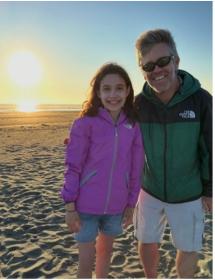
Ava and her dad
My dad had a unique form of younger-onset Alzheimer’s disease. Since my dad’s official diagnosis, I have learned about warning signs or symptoms of the disease that my family was not aware of. One of the hardest symptoms for me to understand or cope with was apathy. My dad didn’t react the way he used to.
He stopped showing interest in what I cared about or what was happening with me. If I was upset, sad or sick, he no longer responded in the ways I expected from my dad. He was distant and it seemed like he did not care anymore. I felt hurt by this behavior until a doctor educated my family that apathy is an early symptom of younger-onset Alzheimer’s disease and it can affect relationships.
I learned the disease changes the brain in ways that make it difficult for someone with younger-onset Alzheimer’s disease to show emotion or interest even when they still care for their family. It was comforting to know that the apathy my dad displayed was not a choice, but a symptom of the disease. For my dad, the apathy got better when the doctor gave him medication for his illness.
Knowing apathy was a symptom made things a little easier, but it didn’t erase how much the disease changed my life and my relationship with my dad. Little by little, the roles reversed, my dad stopped caring for my needs, and I started caring for his.
Sometimes it’s hard not knowing what our relationship would have been like if he had stayed healthy. For example, my dad loved running and playing golf, two things I enjoy now. If he had stayed healthy, we would have shared so much more, and our relationship would have grown deeper. I’ll miss having him to talk to, celebrating accomplishments together, graduations, learning to drive with him, and having him be part of my everyday life. Younger-onset Alzheimer’s disease did not just steal my dad’s future, it also stole pieces of my childhood.
I am 14 years old now, and I lost my dad earlier this year at the age of 55. It sometimes does not feel real that he is gone. His loss has completely reshaped my life and my mom’s in ways we never expected. I shared some of the ways the disease changed my life above, and I hope to share more in future articles. If you are growing up with a parent with younger-onset Alzheimer’s disease, I hope you know that you are not alone.
Talking to someone you trust, asking questions, and learning more about younger-onset Alzheimer’s disease can help you understand the patient’s behaviors. Ask your parents or guardian to be transparent with you about what is happening. My parents were transparent with me from the beginning, which helped a lot. Everyone's experience with Alzheimer's is different, but the loss of a parent during childhood is a pain we have in common. I hope sharing my story reminds you that it’s okay to feel mad, sad, confused, or frustrated, and that you don't have to go through this alone. I hope to connect with you again via future articles and bring light to the impact of younger-onset Alzheimer’s disease on kids and teens.
Here, I want to share the poem I wrote for my dad’s memorial in his honor.
You saw me take my first breath,
and I saw you take your last.
Life isn’t fair, you were taken too soon,
your time with us went far too fast.
With tearful eyes we watched you,
and saw you pass away,
and although we love you dearly,
we couldn’t make you stay.
Alzheimer’s came too early,
and shifted life’s whole tide,
and all the memories left to make
were ones we’d been denied.
There’s so much you won’t get to see,
all the years still yet to come,
and I wish you could be with me
as I grow into who I’ll become.
Even when things changed,
and some moments slipped away,
we still had moments full of joy,
ones I’ll hold close every day.
There’s so much from those early years
I struggle to recall,
but some moments still remain
the ones that stayed through it all.
I think of the nights you read to me,
an ending to each day,
the pages turning one by one,
those moments will never fade away.
I think of our road trips,
the long drives we would share,
these are the kind of moments
I’ll carry everywhere.
I think of snowball fights we had,
the laughter in the cold,
those winter days with you
are memories I’ll always hold.
I think of birthdays and holidays,
the joy you would share,
the way your spirit lit the room
and brought a brightness there.
Those special memories with you
will always bring a smile.
If only I could have you back,
even for a little while
Though I will always miss you, Dad,
I know you’re by my side
in laughter and in sorrow,
in sunshine and in rain.
I’ll feel your presence
through joy and through pain.
by Ava Sophie


__media-listing.png)

