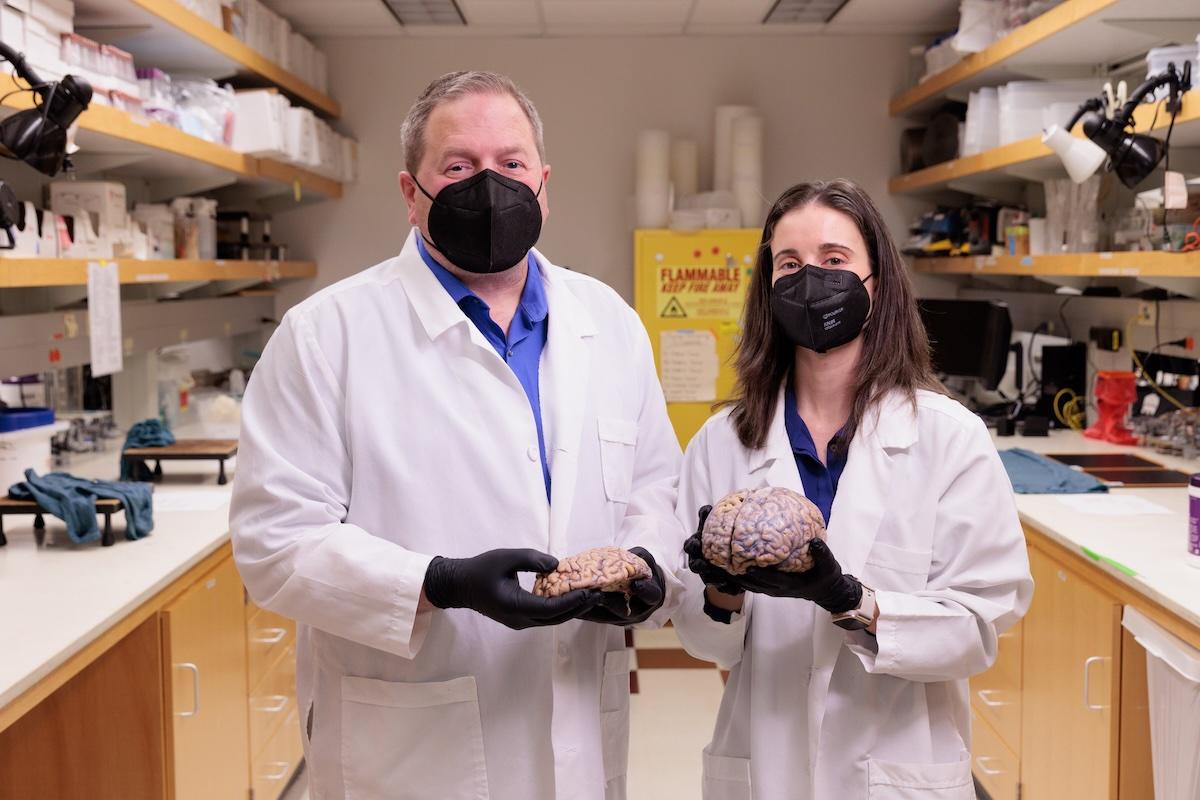
Photo credit: Erika Schultz / The Seattle Times. Permission for single-story use by the UW Memory and Brain Wellness Center. Not for re-use.
“This is the baton transfer of the century,” says Thomas Grabowski, MD, Director of the UW Memory and Brain Wellness Center. He is referring to the recent career transition of C. Dirk Keene, MD, PhD, who led the UW Alzheimer’s Disease Research Center’s Precision Neuropathology Core (PNC).
Keene is a renowned expert on studying brain changes in aging, traumatic brain injury, and Alzheimer’s disease and related dementias. This year, he handed this UW ADRC leadership to his longtime colleague and PNC co-leader, Caitlin Latimer, MD, PhD, associate professor of laboratory medicine and pathology at UW School of Medicine.
Keene now serves as the new chair of the Department of Pathology at the UC San Diego School of Medicine. UW ADRC faculty and staff wish him well as he begins overseeing and implementing strategies to advance education, clinical care, and research in a new department.
A central part of his work at the UW School of Medicine focused on building high-quality brain banks and collaborative data sharing to advance Alzheimer’s research. In founding the UW BRaIN Lab and the Pacific Northwest Brain Donor Network, Keene helped build the infrastructure that provides access to brain tissue and its resulting clinical, imaging, and genetic data generated within the UW ADRC. These tissues, always anonymized, are shared with research partners around the world to amplify the impact each donor has in the search for new treatments.
In my view, Dr. Keene’s greatest accomplishment has been making the UW ADRC Neuropathology Core one of the best, if not the best, in the country.
Thomas Bird, MD
“In my view, Dr. Keene’s greatest accomplishment has been making the UW ADRC Neuropathology Core one of the best, if not the best, in the country,” says Thomas Bird, MD, UW ADRC emeritus faculty, who worked closely with Keene in the Neuropathology-Neurogenetics group that supports junior faculty. “He is a leader in the field and a model for all the other ADRC centers.”
As leader of the UW ADRC Precision Neuropathology Core, Keene maintained robust local collaborations with the Allen Brain Institute and the Adult Changes in Thought Study of the Kaiser Permanente Health Research Institute. With these partners, Keene helped lead the Seattle Alzheimer’s Disease Brain Cell Atlas, a project to understand how Alzheimer’s disease starts and progresses in the human brain. Research using this data revealed that certain types of neurons are selectively vulnerable to the disease and others increase in abundance, helping to identify potential treatment targets.
“Dr. Keene is leaving these effective collaborations and high-quality material resources in Dr. Latimer’s care,” says Grabowski. “She has been his faithful understudy for years and is well prepared for this position. The fact that this transition is going to feel seamless is because of the uniqueness of the UW BRaIN Lab and what Drs. Keene and Latimer have been able to build together.”
With Keene as a supportive partner, Latimer has led the UW ADRC’s work on the mechanisms behind resilience, or the ability of an individual to maintain normal cognition during life despite having Alzheimer’s pathology in their brain. One of her key findings is that presence of a protein called TDP43 in the brain can undermine the capacity for resilience.
Along with his spirit of support and collaboration, Keene is known for his gratitude for ADRC research participants and families who agree to brain donation. As Keene often says, “brain donation is the most incredible gift a person can give to science.” • Genevieve Wanucha

__media-listing.png)


