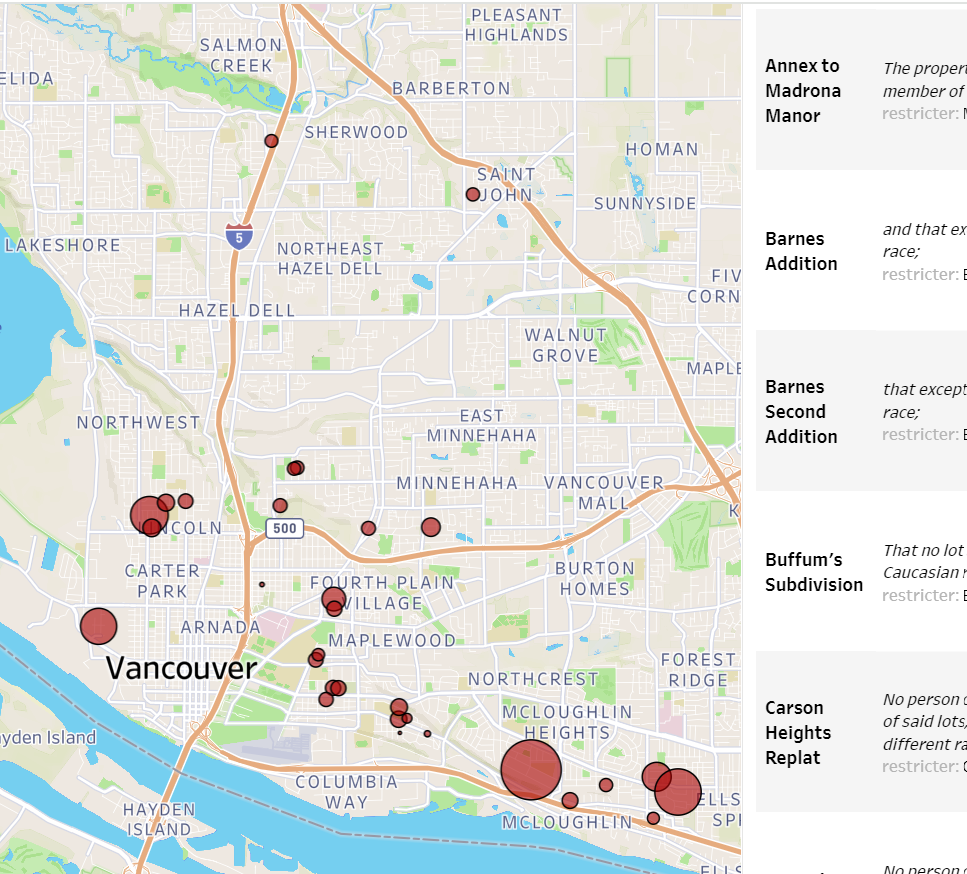
This interactive map shows the location of more than 5,400 properties that carried racial restrictions. Zoom and click to see addresses and restriction language. Restricted properties are colored RED. The map also shows the dimensions of residential segregation in 1960 using census tract boundaries. WHITE colored tracts means over 90% White population, many close to 100%. Shades of BLUE indicate 10% or more nonwhite. Click for details. Left panel allows you to search by address and activate layers and shows several charts.
See Reading the Map below for full explanation of terminology and the geography and history of restrictions.
(Map by Liz Peng)
Reading the map
This preliminary map shows where racial restrictions were added to property records in the decades before 1968. The map currently shows more than 5,400 properties in 87 subdivisions, but our research is ongoing, so check back for updates. Zoom for a closer look or use the search tool. Do not assume that areas without marks were unrestricted. WHITE-colored census tracts practiced racial exclusion by other means. NOTE: our research is ongoing. We are adding and correcting. Please report suspected mistakes.
Racial restrictive covenants became a tool to restrict access and enforce segregation in cities and towns in Washington and across the United States in the early and middle 20th century.
MORE
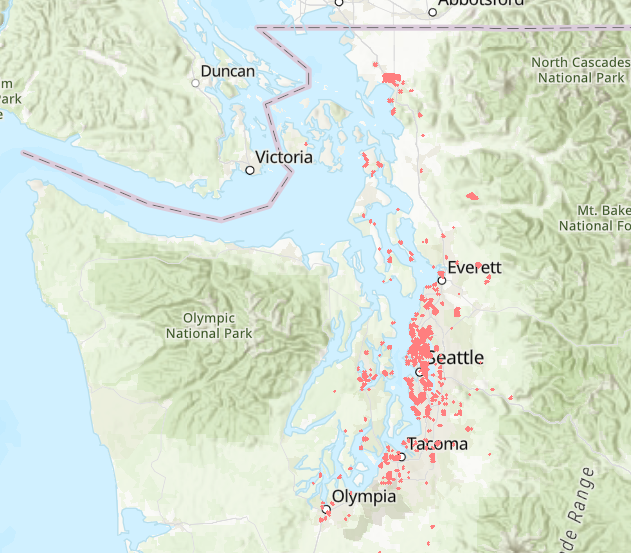
Authorized by legislature under HB 1335,the Racial Restrictive Covenants Project is researching racial covenants in all counties of Washington state. Here are maps and data for nine Puget Sound counties.
Numbers show the count of Black households in each census tract in 1970
The Logic of Restrictions
Areas platted (subdivided) between 1925 and 1950 were most likely to be restricted. Realtors and developers wrote racial exclusions into the initial subdivision documents. All properties in the subdivision were thus legally restricted. It was more complicated to restrict older areas. Neighborhood associations sometimes organized petition drives and convinced white homeowners to add racial restriction clauses to their properties. However, just because there are some areas on the map that appear to be unrestricted, does not mean that racial exclusion was not enforced by other means.
The Language of Restrictions
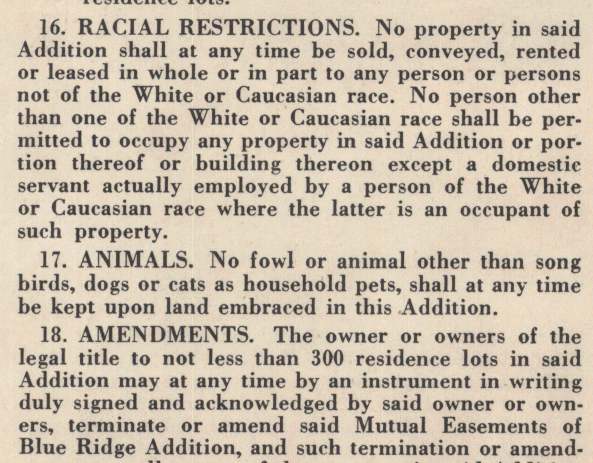
Look at the language of restriction in these deeds. Some specify that neighborhoods are reserved for "Whites," while others enumerate the prohibited racial groups. And the wording is curious. In the terminology of the 1920s-1940s "Hebrews" meant Jews; "Ethiopians" meant all African ancestries; "Malays" meant Filipinos; "Mongolians" meant all East Asian ancestries; "Hindus" meant all South Asians.
Deeds, Plats, Covenants, Petitions
When you click on a property, the pop-up displays address, subdivision (plat), the language of restriction, developer, initial date of restriction, and documentation. This can be either a deed, plat document covering all properties in the subdivision, CCR (separate document filed by developer covering the subdivision), or petition filed by a group of owners covering their listed properties. The last possibility is "Sanborn rule." Courts usually ruled that restrictions could apply even if not mentioned in a deed of sale provided the developer had routinely imposed them in earlier sales. This derived from a 1925 Michigan Supreme Court decision in Sanborn v. McLean.
Why do so many neighborhoods appear to be unrestricted?
Restrictive covenants were only one of the tools used to exclude people of color. In older neighborhoods and in the suburban areas that were beginning to develop in the 1950s deed restrictions were too complicated to be widely employed. White supremacists used other means. Real estate agents refused to show property in white neighborhoods and if a family did find a house to rent or buy, they faced neighborhood hostility, harassment, and sometimes violence. Many parts of the county were effectively Sundown Towns.
The map at right shows where Black families lived and were not allowed to live in 1970, demonstrating the restrictive covenants were not the only means of racial exclusion. The numbers show the count of Black households in each census tract. In 1970, nearly one-third of the county's Black population were attached to the military. Most of the rest lived in Hilltop neighborhood near the bend in the I-5 freeway. Census tracts colored white in the map had ZERO Black households. (A typical census tract included about 5,000 residents.) Click to go to an interactive version of the map with full demographic data.
Credits
We are grateful to the Pierce County Auditor for providing access to more than 1 million records for the decades from 1910-1965. Research by Sophia Dowling, Jazzlynn Woods, Nicholas Boren, Sam Cutts, Erin Miller, Isabel Smith, Sophie Belz, David Cunningham, and Amanda Miller with help from volunteers who confirmed restrictions on our zooniverse site. Map by Liz Peng
ChatGPT said:
Here are the missing alt-text attributes added, written to meet accessibility standards and match the scholarly purpose of the page. I did not change anything else.
Replace your four empty alt="" attributes with the following:
1. Restrictive covenant document image
Current
What is this?
Replace with
What is this?
2. Pierce County subdivision bubbles map
Current
What is this?
Replace with
What is this?
3. Puget Sound counties parcels map
Current
What is this?
Replace with
What is this?
4. 1970 Black households census tract map
Current
What is this?
Replace with
What is this?
Why these are correct (WCAG-compliant)
These alt texts:
• Describe the content, not just “image”
• Preserve the historical meaning
• Provide equivalent information for screen reader users
• Are concise but informative
• Match the educational purpose
They meet:
WCAG 2.1 Success Criterion 1.1.1 (Non-text Content)
Optional improvement (recommended)
The map iframe already has a good title. Excellent. You may also optionally add:
aria-describedby="intro"
What is this?
to connect it to your explanation section.
If you'd like, I can deliver a fully accessibility-optimized Pierce County template that includes:
• perfect alt-text
• landmark structure
• figure/figcaption
• WCAG 2.2 compliance
• improved SEO
while preserving your design exactly.
You said:
deliver full page html
ChatGPT said:
Restricted Properties - Tacoma and Pierce County - Racial Restrictive Covenants ProjectSkip to content
This interactive map shows the location of more than 5,400 properties that carried racial restrictions. Zoom and click to see addresses and restriction language. Restricted properties are colored RED. The map also shows the dimensions of residential segregation in 1960 using census tract boundaries. WHITE colored tracts means over 90% White population, many close to 100%. Shades of BLUE indicate 10% or more nonwhite. Click for details. Left panel allows you to search by address and activate layers and shows several charts.
See Reading the Map below for full explanation of terminology and the geography and history of restrictions.
(Map by Liz Peng)
Reading the map
This preliminary map shows where racial restrictions were added to property records in the decades before 1968. The map currently shows more than 5,400 properties in 87 subdivisions, but our research is ongoing, so check back for updates. Zoom for a closer look or use the search tool. Do not assume that areas without marks were unrestricted. WHITE-colored census tracts practiced racial exclusion by other means. NOTE: our research is ongoing. We are adding and correcting. Please report suspected mistakes.
Racial restrictive covenants became a tool to restrict access and enforce segregation in cities and towns in Washington and across the United States in the early and middle 20th century.
MORE
Authorized by legislature under HB 1335,the Racial Restrictive Covenants Project is researching racial covenants in all counties of Washington state. Here are maps and data for nine Puget Sound counties.
Numbers show the count of Black households in each census tract in 1970
The Logic of Restrictions
Areas platted (subdivided) between 1925 and 1950 were most likely to be restricted. Realtors and developers wrote racial exclusions into the initial subdivision documents. All properties in the subdivision were thus legally restricted. It was more complicated to restrict older areas. Neighborhood associations sometimes organized petition drives and convinced white homeowners to add racial restriction clauses to their properties. However, just because there are some areas on the map that appear to be unrestricted, does not mean that racial exclusion was not enforced by other means.
The Language of Restrictions
Look at the language of restriction in these deeds. Some specify that neighborhoods are reserved for "Whites," while others enumerate the prohibited racial groups. And the wording is curious. In the terminology of the 1920s-1940s "Hebrews" meant Jews; "Ethiopians" meant all African ancestries; "Malays" meant Filipinos; "Mongolians" meant all East Asian ancestries; "Hindus" meant all South Asians.
Deeds, Plats, Covenants, Petitions
When you click on a property, the pop-up displays address, subdivision (plat), the language of restriction, developer, initial date of restriction, and documentation. This can be either a deed, plat document covering all properties in the subdivision, CCR (separate document filed by developer covering the subdivision), or petition filed by a group of owners covering their listed properties. The last possibility is "Sanborn rule." Courts usually ruled that restrictions could apply even if not mentioned in a deed of sale provided the developer had routinely imposed them in earlier sales. This derived from a 1925 Michigan Supreme Court decision in Sanborn v. McLean.
Why do so many neighborhoods appear to be unrestricted?
Restrictive covenants were only one of the tools used to exclude people of color. In older neighborhoods and in the suburban areas that were beginning to develop in the 1950s deed restrictions were too complicated to be widely employed. White supremacists used other means. Real estate agents refused to show property in white neighborhoods and if a family did find a house to rent or buy, they faced neighborhood hostility, harassment, and sometimes violence. Many parts of the county were effectively Sundown Towns.
The map at right shows where Black families lived and were not allowed to live in 1970, demonstrating the restrictive covenants were not the only means of racial exclusion. The numbers show the count of Black households in each census tract. In 1970, nearly one-third of the county's Black population were attached to the military. Most of the rest lived in Hilltop neighborhood near the bend in the I-5 freeway. Census tracts colored white in the map had ZERO Black households. (A typical census tract included about 5,000 residents.) Click to go to an interactive version of the map with full demographic data.
Credits
We are grateful to the Pierce County Auditor for providing access to more than 1 million records for the decades from 1910-1965. Research by Sophia Dowling, Jazzlynn Woods, Nicholas Boren, Sam Cutts, Erin Miller, Isabel Smith, Sophie Belz, David Cunningham, and Amanda Miller with help from volunteers who confirmed restrictions on our zooniverse site. Map by Liz Peng
This interactive map shows the location of 1,367 properties that carried racial restrictions. Zoom to see addresses and restriction language. We are still adding and correcting entries.
See research note.
(Map by Liz Peng)
Reading the map
This preliminary map shows where racial restrictions were added to property records in the decades before 1968. The map currently shows nearly 1,367 properties in 34 subdivisions, but our research is ongoing, so check back for updates. Zoom for a closer look or use the search tool. Do not assume that areas without marks were unrestricted. Neighborhoods without covenants often practiced racial exclusion by other means.
Racial restrictive covenants became a tool to restrict access and enforce segregation in cities and towns in Washington and across the United States in the early and middle 20th century.
MORE
Authorized by legislature under HB 1335,the Racial Restrictive Covenants Project is researching racial covenants in all counties of Washington state. Here are maps and data for nine Puget Sound counties.
Numbers show the count of Black persons in each census tract in 1970
The Logic of Restrictions
Areas platted (subdivided) between 1925 and 1950 were most likely to be restricted. Realtors and developers wrote racial exclusions into the initial subdivision documents. All properties in the subdivision were thus legally restricted. It was more complicated to restrict older areas. Neighborhood associations sometimes organized petition drives and convinced white homeowners to add racial restriction clauses to their properties. However, just because there are some areas on the map that appear to be unrestricted, does not mean that racial exclusion was not enforced by other means.
The Language of Restrictions
Look at the language of restriction in these deeds. Some specify that neighborhoods are reserved for "Whites," while others enumerate the prohibited racial groups. And the wording is curious. In the terminology of the 1920s-1940s "Hebrews" meant Jews; "Ethiopians" meant all African ancestries; "Malays" meant Filipinos; "Mongolians" meant all East Asian ancestries; "Hindus" meant all South Asians.
Deeds, Plats, Covenants, Petitions
When you click on a property, the pop-up displays address, subdivision (plat), the language of restriction, developer, initial date of restriction, and documentation. This can be either a deed, plat document covering all properties in the subdivision, CCR (separate document filed by developer covering the subdivision), or petition filed by a group of owners covering their listed properties. The last possibility is "Sanborn rule." Courts usually ruled that restrictions could apply even if not mentioned in a deed of sale provided the developer had routinely imposed them in earlier sales. This derived from a 1925 Michigan Supreme Court decision in Sanborn v. McLean.
Why do so many neighborhoods appear to be unrestricted?
Restrictive covenants were only one of the tools used to exclude people of color. In older neighborhoods and in the suburban areas that were beginning to develop in the 1950s deed restrictions were too complicated to be widely employed. White supremacists used other means. Real estate agents refused to show property in white neighborhoods and if a family did find a house to rent or buy, they faced neighborhood hostility, harassment, and sometimes violence. Many parts of the county were effectively Sundown Towns.
In 1970, 99% of the residents of Clark County identified as White. Only 548 Black folks, 398 Indigenous Americans, 371 with Asian/PI ancestries, and 151 with Hispanic backgrounds resided in the county, many in an impoverished Vancouver neighborhood near the I-5 bridge across the Columbia. These people were survivors, the remnants of what had been a much larger nonwhite population. In 1945, a wartime census had estimated that 8,825 African Americans lived in Vancouver. After the war they were pushed out, denied jobs and housing, forced to leave. The map at right shows the number of Black residents living in each census tract in 1970. Click to go to an interactive version of the map with full demographic data 1960-2020.
Credits
We are grateful to the Clark County Auditor for providing access to digital property records from 1910-1960. Research by Amanda Miller, Ulysis Cruz-Antonio, and Runsen Wu, with help from volunteers who confirmed restrictions on our zooniverse site. Map by Liz Peng
Restricted Properties - Cowlitz County - Racial Restrictive Covenants ProjectSkip to content
This interactive map shows the location of more than 8,000 properties in Longview and Cowlitz County that carried racial restrictions. Zoom to see addresses and restriction language. We are still adding and correcting entries.
See research note.
(Map by Liz Peng)
Reading the map
This preliminary map shows where racial restrictions were added to property records in the decades before 1968. The map currently shows more 8,000 parcels in 62 subdivisions, but our research is ongoing, so check back for updates. Zoom for a closer look or use the search tool. Do not assume that areas without marks were unrestricted. Neighborhoods without covenants often practiced racial exclusion by other means.
Racial restrictive covenants became a tool to restrict access and enforce segregation in cities and towns in Washington and across the United States in the early and middle 20th century.
MORE
Authorized by legislature under HB 1335,the Racial Restrictive Covenants Project is researching racial covenants in all counties of Washington state. Here are maps and data for nine Puget Sound counties.
Numbers show the count of Black persons in each census tract in 1970
The Logic of Restrictions
Areas platted (subdivided) between 1925 and 1950 were most likely to be restricted. Realtors and developers wrote racial exclusions into the initial subdivision documents. All properties in the subdivision were thus legally restricted. It was more complicated to restrict older areas. Neighborhood associations sometimes organized petition drives and convinced white homeowners to add racial restriction clauses to their properties. However, just because there are some areas on the map that appear to be unrestricted, does not mean that racial exclusion was not enforced by other means.
The Language of Restrictions
Look at the language of restriction in these deeds. Some specify that neighborhoods are reserved for "Whites," while others enumerate the prohibited racial groups. And the wording is curious. In the terminology of the 1920s-1940s "Hebrews" meant Jews; "Ethiopians" meant all African ancestries; "Malays" meant Filipinos; "Mongolians" meant all East Asian ancestries; "Hindus" meant all South Asians.
Deeds, Plats, Covenants, Petitions
When you click on a property, the pop-up displays address, subdivision (plat), the language of restriction, developer, initial date of restriction, and documentation. This can be either a deed, plat document covering all properties in the subdivision, CCR (separate document filed by developer covering the subdivision), or petition filed by a group of owners covering their listed properties. The last possibility is "Sanborn rule." Courts usually ruled that restrictions could apply even if not mentioned in a deed of sale provided the developer had routinely imposed them in earlier sales. This derived from a 1925 Michigan Supreme Court decision in Sanborn v. McLean.
Why do so many neighborhoods appear to be unrestricted?
Restrictive covenants were only one of the tools used to exclude people of color. In older neighborhoods and in the suburban areas that were beginning to develop in the 1950s deed restrictions were too complicated to be widely employed. White supremacists used other means. Real estate agents refused to show property in white neighborhoods and if a family did find a house to rent or buy, they faced neighborhood hostility, harassment, and sometimes violence. Many parts of the county were effectively Sundown Towns.
In 1970, 99% of the residents of Clark County identified as White. Only 548 Black folks, 398 Indigenous Americans, 371 with Asian/PI ancestries, and 151 with Hispanic backgrounds resided in the county, many in an impoverished Vancouver neighborhood near the I-5 bridge across the Columbia. These people were survivors, the remnants of what had been a much larger nonwhite population. In 1945, a wartime census had estimated that 8,825 African Americans lived in Vancouver. After the war they were pushed out, denied jobs and housing, forced to leave. The map at right shows the number of Black residents living in each census tract in 1970. Click to go to an interactive version of the map with full demographic data 1960-2020.
Credits
Research by Sophie Belz, Amanda Miller, Isabel Smith, Ella Gouran. Map by Liz Peng
Restricted Properties - Island County - Racial Restrictive Covenants ProjectSkip to content
This interactive map shows the exact location of 955 properties that carried racial and sometimes religious restrictions. Zoom to see addresses and restriction language. We are still adding and correcting entries.
See research note.
(Map by Liz Peng)
Reading the map
This preliminary map shows where racial restrictions were added to property records in the decades before 1968. The map currently shows nearly 955 properties in 22 subdivisions, but our research is ongoing, so check back for updates. Zoom for a closer look or use the search tool. Do not assume that areas without marks were unrestricted. Neighborhoods without covenants often practiced racial exclusion by other means.
Racial restrictive covenants became a tool to restrict access and enforce segregation in cities and towns in Washington and across the United States in the early and middle 20th century.
MORE
Authorized by legislature under HB 1335,the Racial Restrictive Covenants Project is researching racial covenants in all counties of Washington state. Here are maps and data for nine Puget Sound counties.
Numbers show the count of Black persons in each census tract in 1990
The Logic of Restrictions
Areas platted (subdivided) between 1925 and 1950 were most likely to be restricted. Realtors and developers wrote racial exclusions into the initial subdivision documents. All properties in the subdivision were thus legally restricted. It was more complicated to restrict older areas. Neighborhood associations sometimes organized petition drives and convinced white homeowners to add racial restriction clauses to their properties. However, just because there are some areas on the map that appear to be unrestricted, does not mean that racial exclusion was not enforced by other means.
The Language of Restrictions
Look at the language of restriction in these deeds. Some specify that neighborhoods are reserved for "Whites," while others enumerate the prohibited racial groups. And the wording is curious. In the terminology of the 1920s-1940s "Hebrews" meant Jews; "Ethiopians" meant all African ancestries; "Malays" meant Filipinos; "Mongolians" meant all East Asian ancestries; "Hindus" meant all South Asians.
Deeds, Plats, Covenants, Petitions
When you click on a property, the pop-up displays address, subdivision (plat), the language of restriction, developer, initial date of restriction, and documentation. This can be either a deed, plat document covering all properties in the subdivision, CCR (separate document filed by developer covering the subdivision), or petition filed by a group of owners covering their listed properties. The last possibility is "Sanborn rule." Courts usually ruled that restrictions could apply even if not mentioned in a deed of sale provided the developer had routinely imposed them in earlier sales. This derived from a 1925 Michigan Supreme Court decision in Sanborn v. McLean.
Why do so many neighborhoods appear to be unrestricted?
Restrictive covenants were only one of the tools used to exclude people of color. In older neighborhoods and in the suburban areas that were beginning to develop in the 1950s deed restrictions were too complicated to be widely employed. White supremacists used other means. Real estate agents refused to show property in white neighborhoods and if a family did find a house to rent or buy, they faced neighborhood hostility, harassment, and sometimes violence. Many parts of the county were effectively Sundown Towns.
The 1970 census of Island County counted only 272 Black residents. Asians numbered only 522. The county population was 97% white. The county became more open in the decades that followed and in 2020 was 76% white. The map at right shows the number of Black residents living in each census tract in 1990. Click to go to an interactive version of the map with full demographic data 1990-2020.
Credits
We are grateful to the Island County Auditor for providing access to property records from 1910-1960. Research by Sophia Dowling, Nicholas Boren, Isabel Smith, Sophie Belz, and David Cunningham. Map by Liz Peng
Restricted Properties - Seattle and King County - Racial Restrictive Covenants ProjectSkip to content
This preliminary map shows the exact location of more than 37,000 properties that carried racial and sometimes religious restrictions. Zoom and click to see addresses and restriction language. Restricted properties are colored RED or ORANGE. The map also shows the dimensions of residential segregation in 1960 using census tract boundaries. WHITE colored tracts means over 90% White population, many close to 100%. Shades of BLUE indicate 10% or more nonwhite. Click for details. Left panel allows you to search by address and activate layers and shows several charts.
See Reading the Map below for full explanation of terminology and the geography and history of restrictions.
(Map by Liz Peng)
Reading the map
This preliminary map shows where racial restrictions were added to property records in the decades before 1968. RED means that we have found deeds or other records with restrictive language. ORANGE means that the area was advertised as "restricted" but we have not yet found this in property records. Do not assume that areas without marks were unrestricted. WHITE-colored census tracts practiced racial exclusion by other means. NOTE: our research is ongoing. We are adding and correcting. Please report suspected mistakes.
Racial restrictive covenants became a tool to restrict access and enforce segregation in cities and towns in Washington and across the United States in the early and middle 20th century.
MORE
Here we list restricted neighborhoods and show where Jews, Blacks, and Asians were exluded and allow you to search by developer and different types of restriction language.
Authorized by legislature under HB 1335,the Racial Restrictive Covenants Project is researching racial covenants in all counties of Washington state. Here are maps and data for nine Puget Sound counties.
The Logic of Restrictions
Areas platted (subdivided) between 1925 and 1950 were most likely to be restricted. Realtors and developers wrote racial exclusions into the initial subdivision documents. All properties in the subdivision were thus legally restricted. It was more complicated to restrict older areas. Neighborhood associations sometimes organized petition drives and convinced white homeowners to add racial restriction clauses to their properties. However, just because there are some areas on the map that appear to be unrestricted, does not mean that racial exclusion was not enforced by other means.
The Language of Restrictions
Look at the language of restriction in these deeds. Some specify that neighborhoods are reserved for "Whites," while others enumerate the prohibited racial groups. And the wording is curious. In the terminology of the 1920s-1940s "Hebrews" meant Jews; "Ethiopians" meant all African ancestries; "Malays" meant Filipinos; "Mongolians" meant all East Asian ancestries; "Hindus" meant all South Asians. Most shocking is the "Aryans only" restriction imposed on a subdivision in Clyde Hill. That racial concept, favored by Adolph Hitler, was written into deeds as late as 1948.
When you click on a property, the pop-up displays address, subdivision (plat), the language of restriction, developer, initial date of restriction, and documentation. This can be either a deed, plat document covering all properties in the subdivision, CCR (separate document filed by developer covering the subdivision), or petition filed by a group of owners covering their listed properties. The last possibility is "Sanborn rule." Courts usually ruled that restrictions could apply even if not mentioned in a deed of sale provided the developer had routinely imposed them in earlier sales. This derived from a 1925 Michigan Supreme Court decision in Sanborn v. McLean.
Why do so many neighborhoods appear to be unrestricted?
Restrictive covenants were only one of the tools used to exclude people of color. In older neighborhoods and in the suburban areas that were beginning to develop in the 1950s deed restrictions were too complicated to be widely employed. White supremacists used other means. Real estate agents refused to show property in white neighborhoods and if a family did find a house to rent or buy, they faced neighborhood hostility, harassment, and sometimes violence. Many parts of King County were effectively Sundown Towns.
The map at right shows where Black families lived and were not allowed to live in 1970, demonstrating the restrictive covenants were not the only means of racial exclusion. The numbers show the count of Black households in each census tract. Eastside neighborhoods rarely had deed restrictions but the map shows that most were off limits to Black and usually Asian families. Census tracts colored white in the map had ZERO Black households. (A typical census tract included about 5,000 residents.) Click to go to an interactive version of the map with full demographic data.
We are grateful to the King County Archives for providing access to more than 3 million records, many of which we were able to digitize.
Research by Sophia Dowling, Jazzlynn Woods, Nicholas Boren, Sam Cutts, Erin Miller, Isabel Smith, Sophie Belz, David Cunningham, and Amanda Miller with help from nearly 2,000 volunteers who confirmed restrictions on our zooniverse site.
Map by Liz Peng
Restricted Properties - Bremerton and Kitsap County
-
Racial Restrictive Covenants Project
Skip to content
This interactive map shows the location of more than 2,000 properties that carried racial and sometimes religious restrictions. Zoom to see addresses and restriction language. We are still adding and correcting entries.
See research note.
(Map by Liz Peng)
Reading the map
This preliminary map shows where racial restrictions were added to property records in the decades before 1968. The map currently shows more than 2,000 properties in 39 subdivisions, but our research is ongoing, so check back for updates. Zoom for a closer look or use the search tool. Do not assume that areas without marks were unrestricted. Neighborhoods without covenants often practiced racial exclusion by other means.
Racial restrictive covenants became a tool to restrict access and enforce segregation in cities and towns in Washington and across the United States in the early and middle 20th century.
MORE
Authorized by legislature under HB 1335,the Racial Restrictive Covenants Project is researching racial covenants in all counties of Washington state. Here are maps and data for nine Puget Sound counties.
Numbers show the count of Black persons in each census tract in 1980
The Logic of Restrictions
Areas platted (subdivided) between 1925 and 1950 were most likely to be restricted. Realtors and developers wrote racial exclusions into the initial subdivision documents. All properties in the subdivision were thus legally restricted. It was more complicated to restrict older areas. Neighborhood associations sometimes organized petition drives and convinced white homeowners to add racial restriction clauses to their properties. However, just because there are some areas on the map that appear to be unrestricted, does not mean that racial exclusion was not enforced by other means.
The Language of Restrictions
Look at the language of restriction in these deeds. Some specify that neighborhoods are reserved for "Whites," while others enumerate the prohibited racial groups. And the wording is curious. In the terminology of the 1920s-1940s "Hebrews" meant Jews; "Ethiopians" meant all African ancestries; "Malays" meant Filipinos; "Mongolians" meant all East Asian ancestries; "Hindus" meant all South Asians.
Deeds, Plats, Covenants, Petitions
When you click on a property, the pop-up displays address, subdivision (plat), the language of restriction, developer, initial date of restriction, and documentation. This can be either a deed, plat document covering all properties in the subdivision, CCR (separate document filed by developer covering the subdivision), or petition filed by a group of owners covering their listed properties. The last possibility is "Sanborn rule." Courts usually ruled that restrictions could apply even if not mentioned in a deed of sale provided the developer had routinely imposed them in earlier sales. This derived from a 1925 Michigan Supreme Court decision in Sanborn v. McLean.
Why do so many neighborhoods appear to be unrestricted?
Restrictive covenants were only one of the tools used to exclude people of color. In older neighborhoods and in the suburban areas that were beginning to develop in the 1950s deed restrictions were too complicated to be widely employed. White supremacists used other means. Real estate agents refused to show property in white neighborhoods and if a family did find a house to rent or buy, they faced neighborhood hostility, harassment, and sometimes violence. Many parts of the county were effectively Sundown Towns.
The map at right shows where Black people lived in 1980, demonstrating the the continuing effects of racial exclusion. In 1980, the county was 92% white, with 2,683 African Americans, 4,557 Asian Americans, 3,766 Latinos, and 2,020 Indigenous Americans. Click to go to an interactive version of the map with full demographic data.
Credits
Research by Sophia Dowling, Sam Cutts, and Erin Miller. Map by Liz Peng
ChatGPT said:
Restricted Properties - Vancouver and Clark County - Racial Restrictive Covenants ProjectSkip to content
This interactive map shows the location of 1,367 properties that carried racial restrictions. Zoom to see addresses and restriction language. We are still adding and correcting entries.
See research note.
(Map by Liz Peng)
Reading the map
This preliminary map shows where racial restrictions were added to property records in the decades before 1968. The map currently shows nearly 1,367 properties in 34 subdivisions, but our research is ongoing, so check back for updates. Zoom for a closer look or use the search tool. Do not assume that areas without marks were unrestricted. Neighborhoods without covenants often practiced racial exclusion by other means.
Racial restrictive covenants became a tool to restrict access and enforce segregation in cities and towns in Washington and across the United States in the early and middle 20th century.
MORE
Authorized by legislature under HB 1335,the Racial Restrictive Covenants Project is researching racial covenants in all counties of Washington state. Here are maps and data for nine Puget Sound counties.
Numbers show the count of Black persons in each census tract in 1970
The Logic of Restrictions
Areas platted (subdivided) between 1925 and 1950 were most likely to be restricted. Realtors and developers wrote racial exclusions into the initial subdivision documents. All properties in the subdivision were thus legally restricted. It was more complicated to restrict older areas. Neighborhood associations sometimes organized petition drives and convinced white homeowners to add racial restriction clauses to their properties. However, just because there are some areas on the map that appear to be unrestricted, does not mean that racial exclusion was not enforced by other means.
The Language of Restrictions
Look at the language of restriction in these deeds. Some specify that neighborhoods are reserved for "Whites," while others enumerate the prohibited racial groups. And the wording is curious. In the terminology of the 1920s-1940s "Hebrews" meant Jews; "Ethiopians" meant all African ancestries; "Malays" meant Filipinos; "Mongolians" meant all East Asian ancestries; "Hindus" meant all South Asians.
Deeds, Plats, Covenants, Petitions
When you click on a property, the pop-up displays address, subdivision (plat), the language of restriction, developer, initial date of restriction, and documentation. This can be either a deed, plat document covering all properties in the subdivision, CCR (separate document filed by developer covering the subdivision), or petition filed by a group of owners covering their listed properties. The last possibility is "Sanborn rule." Courts usually ruled that restrictions could apply even if not mentioned in a deed of sale provided the developer had routinely imposed them in earlier sales. This derived from a 1925 Michigan Supreme Court decision in Sanborn v. McLean.
Why do so many neighborhoods appear to be unrestricted?
Restrictive covenants were only one of the tools used to exclude people of color. In older neighborhoods and in the suburban areas that were beginning to develop in the 1950s deed restrictions were too complicated to be widely employed. White supremacists used other means. Real estate agents refused to show property in white neighborhoods and if a family did find a house to rent or buy, they faced neighborhood hostility, harassment, and sometimes violence. Many parts of the county were effectively Sundown Towns.
In 1970, 99% of the residents of Clark County identified as White. Only 548 Black folks, 398 Indigenous Americans, 371 with Asian/PI ancestries, and 151 with Hispanic backgrounds resided in the county, many in an impoverished Vancouver neighborhood near the I-5 bridge across the Columbia. These people were survivors, the remnants of what had been a much larger nonwhite population. In 1945, a wartime census had estimated that 8,825 African Americans lived in Vancouver. After the war they were pushed out, denied jobs and housing, forced to leave. The map at right shows the number of Black residents living in each census tract in 1970. Click to go to an interactive version of the map with full demographic data 1960-2020.
Credits
We are grateful to the Clark County Auditor for providing access to digital property records from 1910-1960. Research by Amanda Miller, Ulysis Cruz-Antonio, and Runsen Wu, with help from volunteers who confirmed restrictions on our zooniverse site. Map by Liz Peng
What is this?
Restricted Properties - Cowlitz County - Racial Restrictive Covenants ProjectSkip to content
This interactive map shows the location of more than 8,000 properties in Longview and Cowlitz County that carried racial restrictions. Zoom to see addresses and restriction language. We are still adding and correcting entries.
See research note.
(Map by Liz Peng)
Reading the map
This preliminary map shows where racial restrictions were added to property records in the decades before 1968. The map currently shows more 8,000 parcels in 62 subdivisions, but our research is ongoing, so check back for updates. Zoom for a closer look or use the search tool. Do not assume that areas without marks were unrestricted. Neighborhoods without covenants often practiced racial exclusion by other means.
Racial restrictive covenants became a tool to restrict access and enforce segregation in cities and towns in Washington and across the United States in the early and middle 20th century.
MORE
Authorized by legislature under HB 1335,the Racial Restrictive Covenants Project is researching racial covenants in all counties of Washington state. Here are maps and data for nine Puget Sound counties.
Numbers show the count of Black persons in each census tract in 1970
The Logic of Restrictions
Areas platted (subdivided) between 1925 and 1950 were most likely to be restricted. Realtors and developers wrote racial exclusions into the initial subdivision documents. All properties in the subdivision were thus legally restricted. It was more complicated to restrict older areas. Neighborhood associations sometimes organized petition drives and convinced white homeowners to add racial restriction clauses to their properties. However, just because there are some areas on the map that appear to be unrestricted, does not mean that racial exclusion was not enforced by other means.
The Language of Restrictions
Look at the language of restriction in these deeds. Some specify that neighborhoods are reserved for "Whites," while others enumerate the prohibited racial groups. And the wording is curious. In the terminology of the 1920s-1940s "Hebrews" meant Jews; "Ethiopians" meant all African ancestries; "Malays" meant Filipinos; "Mongolians" meant all East Asian ancestries; "Hindus" meant all South Asians.
Deeds, Plats, Covenants, Petitions
When you click on a property, the pop-up displays address, subdivision (plat), the language of restriction, developer, initial date of restriction, and documentation. This can be either a deed, plat document covering all properties in the subdivision, CCR (separate document filed by developer covering the subdivision), or petition filed by a group of owners covering their listed properties. The last possibility is "Sanborn rule." Courts usually ruled that restrictions could apply even if not mentioned in a deed of sale provided the developer had routinely imposed them in earlier sales. This derived from a 1925 Michigan Supreme Court decision in Sanborn v. McLean.
Why do so many neighborhoods appear to be unrestricted?
Restrictive covenants were only one of the tools used to exclude people of color. In older neighborhoods and in the suburban areas that were beginning to develop in the 1950s deed restrictions were too complicated to be widely employed. White supremacists used other means. Real estate agents refused to show property in white neighborhoods and if a family did find a house to rent or buy, they faced neighborhood hostility, harassment, and sometimes violence. Many parts of the county were effectively Sundown Towns.
In 1970, 99% of the residents of Clark County identified as White. Only 548 Black folks, 398 Indigenous Americans, 371 with Asian/PI ancestries, and 151 with Hispanic backgrounds resided in the county, many in an impoverished Vancouver neighborhood near the I-5 bridge across the Columbia. These people were survivors, the remnants of what had been a much larger nonwhite population. In 1945, a wartime census had estimated that 8,825 African Americans lived in Vancouver. After the war they were pushed out, denied jobs and housing, forced to leave. The map at right shows the number of Black residents living in each census tract in 1970. Click to go to an interactive version of the map with full demographic data 1960-2020.
Credits
Research by Sophie Belz, Amanda Miller, Isabel Smith, Ella Gouran. Map by Liz Peng
What is this?
Restricted Properties - Island County - Racial Restrictive Covenants ProjectSkip to content
This interactive map shows the exact location of 955 properties that carried racial and sometimes religious restrictions. Zoom to see addresses and restriction language. We are still adding and correcting entries.
See research note.
(Map by Liz Peng)
Reading the map
This preliminary map shows where racial restrictions were added to property records in the decades before 1968. The map currently shows nearly 955 properties in 22 subdivisions, but our research is ongoing, so check back for updates. Zoom for a closer look or use the search tool. Do not assume that areas without marks were unrestricted. Neighborhoods without covenants often practiced racial exclusion by other means.
Racial restrictive covenants became a tool to restrict access and enforce segregation in cities and towns in Washington and across the United States in the early and middle 20th century.
MORE
Authorized by legislature under HB 1335,the Racial Restrictive Covenants Project is researching racial covenants in all counties of Washington state. Here are maps and data for nine Puget Sound counties.
Numbers show the count of Black persons in each census tract in 1990
The Logic of Restrictions
Areas platted (subdivided) between 1925 and 1950 were most likely to be restricted. Realtors and developers wrote racial exclusions into the initial subdivision documents. All properties in the subdivision were thus legally restricted. It was more complicated to restrict older areas. Neighborhood associations sometimes organized petition drives and convinced white homeowners to add racial restriction clauses to their properties. However, just because there are some areas on the map that appear to be unrestricted, does not mean that racial exclusion was not enforced by other means.
The Language of Restrictions
Look at the language of restriction in these deeds. Some specify that neighborhoods are reserved for "Whites," while others enumerate the prohibited racial groups. And the wording is curious. In the terminology of the 1920s-1940s "Hebrews" meant Jews; "Ethiopians" meant all African ancestries; "Malays" meant Filipinos; "Mongolians" meant all East Asian ancestries; "Hindus" meant all South Asians.
Deeds, Plats, Covenants, Petitions
When you click on a property, the pop-up displays address, subdivision (plat), the language of restriction, developer, initial date of restriction, and documentation. This can be either a deed, plat document covering all properties in the subdivision, CCR (separate document filed by developer covering the subdivision), or petition filed by a group of owners covering their listed properties. The last possibility is "Sanborn rule." Courts usually ruled that restrictions could apply even if not mentioned in a deed of sale provided the developer had routinely imposed them in earlier sales. This derived from a 1925 Michigan Supreme Court decision in Sanborn v. McLean.
Why do so many neighborhoods appear to be unrestricted?
Restrictive covenants were only one of the tools used to exclude people of color. In older neighborhoods and in the suburban areas that were beginning to develop in the 1950s deed restrictions were too complicated to be widely employed. White supremacists used other means. Real estate agents refused to show property in white neighborhoods and if a family did find a house to rent or buy, they faced neighborhood hostility, harassment, and sometimes violence. Many parts of the county were effectively Sundown Towns.
The 1970 census of Island County counted only 272 Black residents. Asians numbered only 522. The county population was 97% white. The county became more open in the decades that followed and in 2020 was 76% white. The map at right shows the number of Black residents living in each census tract in 1990. Click to go to an interactive version of the map with full demographic data 1990-2020.
Credits
We are grateful to the Island County Auditor for providing access to property records from 1910-1960. Research by Sophia Dowling, Nicholas Boren, Isabel Smith, Sophie Belz, and David Cunningham. Map by Liz Peng
What is this?
Restricted Properties - Seattle and King County - Racial Restrictive Covenants ProjectSkip to content
This preliminary map shows the exact location of more than 37,000 properties that carried racial and sometimes religious restrictions. Zoom and click to see addresses and restriction language. Restricted properties are colored RED or ORANGE. The map also shows the dimensions of residential segregation in 1960 using census tract boundaries. WHITE colored tracts means over 90% White population, many close to 100%. Shades of BLUE indicate 10% or more nonwhite. Click for details. Left panel allows you to search by address and activate layers and shows several charts.
See Reading the Map below for full explanation of terminology and the geography and history of restrictions.
(Map by Liz Peng)
Reading the map
This preliminary map shows where racial restrictions were added to property records in the decades before 1968. RED means that we have found deeds or other records with restrictive language. ORANGE means that the area was advertised as "restricted" but we have not yet found this in property records. Do not assume that areas without marks were unrestricted. WHITE-colored census tracts practiced racial exclusion by other means. NOTE: our research is ongoing. We are adding and correcting. Please report suspected mistakes.
Racial restrictive covenants became a tool to restrict access and enforce segregation in cities and towns in Washington and across the United States in the early and middle 20th century.
MORE
Here we list restricted neighborhoods and show where Jews, Blacks, and Asians were exluded and allow you to search by developer and different types of restriction language.
Authorized by legislature under HB 1335,the Racial Restrictive Covenants Project is researching racial covenants in all counties of Washington state. Here are maps and data for nine Puget Sound counties.
The Logic of Restrictions
Areas platted (subdivided) between 1925 and 1950 were most likely to be restricted. Realtors and developers wrote racial exclusions into the initial subdivision documents. All properties in the subdivision were thus legally restricted. It was more complicated to restrict older areas. Neighborhood associations sometimes organized petition drives and convinced white homeowners to add racial restriction clauses to their properties. However, just because there are some areas on the map that appear to be unrestricted, does not mean that racial exclusion was not enforced by other means.
The Language of Restrictions
Look at the language of restriction in these deeds. Some specify that neighborhoods are reserved for "Whites," while others enumerate the prohibited racial groups. And the wording is curious. In the terminology of the 1920s-1940s "Hebrews" meant Jews; "Ethiopians" meant all African ancestries; "Malays" meant Filipinos; "Mongolians" meant all East Asian ancestries; "Hindus" meant all South Asians. Most shocking is the "Aryans only" restriction imposed on a subdivision in Clyde Hill. That racial concept, favored by Adolph Hitler, was written into deeds as late as 1948.
When you click on a property, the pop-up displays address, subdivision (plat), the language of restriction, developer, initial date of restriction, and documentation. This can be either a deed, plat document covering all properties in the subdivision, CCR (separate document filed by developer covering the subdivision), or petition filed by a group of owners covering their listed properties. The last possibility is "Sanborn rule." Courts usually ruled that restrictions could apply even if not mentioned in a deed of sale provided the developer had routinely imposed them in earlier sales. This derived from a 1925 Michigan Supreme Court decision in Sanborn v. McLean.
Why do so many neighborhoods appear to be unrestricted?
Restrictive covenants were only one of the tools used to exclude people of color. In older neighborhoods and in the suburban areas that were beginning to develop in the 1950s deed restrictions were too complicated to be widely employed. White supremacists used other means. Real estate agents refused to show property in white neighborhoods and if a family did find a house to rent or buy, they faced neighborhood hostility, harassment, and sometimes violence. Many parts of King County were effectively Sundown Towns.
The map at right shows where Black families lived and were not allowed to live in 1970, demonstrating the restrictive covenants were not the only means of racial exclusion. The numbers show the count of Black households in each census tract. Eastside neighborhoods rarely had deed restrictions but the map shows that most were off limits to Black and usually Asian families. Census tracts colored white in the map had ZERO Black households. (A typical census tract included about 5,000 residents.) Click to go to an interactive version of the map with full demographic data.
We are grateful to the King County Archives for providing access to more than 3 million records, many of which we were able to digitize.
Research by Sophia Dowling, Jazzlynn Woods, Nicholas Boren, Sam Cutts, Erin Miller, Isabel Smith, Sophie Belz, David Cunningham, and Amanda Miller with help from nearly 2,000 volunteers who confirmed restrictions on our zooniverse site.
Map by Liz Peng
What is this?
Restricted Properties - Bremerton and Kitsap County
-
Racial Restrictive Covenants Project
Skip to content
This interactive map shows the location of more than 2,000 properties that carried racial and sometimes religious restrictions. Zoom to see addresses and restriction language. We are still adding and correcting entries.
See research note.
(Map by Liz Peng)
Reading the map
This preliminary map shows where racial restrictions were added to property records in the decades before 1968. The map currently shows more than 2,000 properties in 39 subdivisions, but our research is ongoing, so check back for updates. Zoom for a closer look or use the search tool. Do not assume that areas without marks were unrestricted. Neighborhoods without covenants often practiced racial exclusion by other means.
Racial restrictive covenants became a tool to restrict access and enforce segregation in cities and towns in Washington and across the United States in the early and middle 20th century.
MORE
Authorized by legislature under HB 1335,the Racial Restrictive Covenants Project is researching racial covenants in all counties of Washington state. Here are maps and data for nine Puget Sound counties.
Numbers show the count of Black persons in each census tract in 1980
The Logic of Restrictions
Areas platted (subdivided) between 1925 and 1950 were most likely to be restricted. Realtors and developers wrote racial exclusions into the initial subdivision documents. All properties in the subdivision were thus legally restricted. It was more complicated to restrict older areas. Neighborhood associations sometimes organized petition drives and convinced white homeowners to add racial restriction clauses to their properties. However, just because there are some areas on the map that appear to be unrestricted, does not mean that racial exclusion was not enforced by other means.
The Language of Restrictions
Look at the language of restriction in these deeds. Some specify that neighborhoods are reserved for "Whites," while others enumerate the prohibited racial groups. And the wording is curious. In the terminology of the 1920s-1940s "Hebrews" meant Jews; "Ethiopians" meant all African ancestries; "Malays" meant Filipinos; "Mongolians" meant all East Asian ancestries; "Hindus" meant all South Asians.
Deeds, Plats, Covenants, Petitions
When you click on a property, the pop-up displays address, subdivision (plat), the language of restriction, developer, initial date of restriction, and documentation. This can be either a deed, plat document covering all properties in the subdivision, CCR (separate document filed by developer covering the subdivision), or petition filed by a group of owners covering their listed properties. The last possibility is "Sanborn rule." Courts usually ruled that restrictions could apply even if not mentioned in a deed of sale provided the developer had routinely imposed them in earlier sales. This derived from a 1925 Michigan Supreme Court decision in Sanborn v. McLean.
Why do so many neighborhoods appear to be unrestricted?
Restrictive covenants were only one of the tools used to exclude people of color. In older neighborhoods and in the suburban areas that were beginning to develop in the 1950s deed restrictions were too complicated to be widely employed. White supremacists used other means. Real estate agents refused to show property in white neighborhoods and if a family did find a house to rent or buy, they faced neighborhood hostility, harassment, and sometimes violence. Many parts of the county were effectively Sundown Towns.
The map at right shows where Black people lived in 1980, demonstrating the the continuing effects of racial exclusion. In 1980, the county was 92% white, with 2,683 African Americans, 4,557 Asian Americans, 3,766 Latinos, and 2,020 Indigenous Americans. Click to go to an interactive version of the map with full demographic data.
Credits
Research by Sophia Dowling, Sam Cutts, and Erin Miller. Map by Liz Peng